

Posted by Kyle Lopez // Mar 13, 2026
what I talk about when I talk about running
What does running have to do with it? There’s no true cure to lack of inspiration and a few months ago I could feel myself hitting a wall. Working in an industry where creativity is your livelihood, and not to mention several personal activities that draw from the same source left me feeling a bit numb to the making process. So, like many others before me I went looking for external help. I didn’t expect a perfect solution and that isn’t what I found. What I did find is a memoir by acclaimed fiction author Haruki Murakami. What I Talk About When I Talk About Running isn’t a self-help novel but an honest reflection of how running informs Murakami’s writing process, detailing some of his training for the 2005 New York Marathon and other events of his running career. Throughout the book he touches on his beginnings as a writer and how they seemingly coincided with his start of distance running. A start that was unlikely as he was a 30-year-old, Tokyo jazz-bar owner with a smoking habit when he first wrote and entered a piece to a new writer’s competition for Gunzo magazine in Japan. Murakami explains that running came soon after for him as a way to remain in shape. Managing a bar kept him on his feet for hours but writing left him stagnant for most of the day. The shift was major though. He started waking up early, quit smoking, started writing full time. With this came some insights that struck me as particularly significant:
“When I’m criticized unjustly (from my viewpoint at least) … I go running for a little longer than usual. By running longer it’s like I can physically exhaust that portion of my 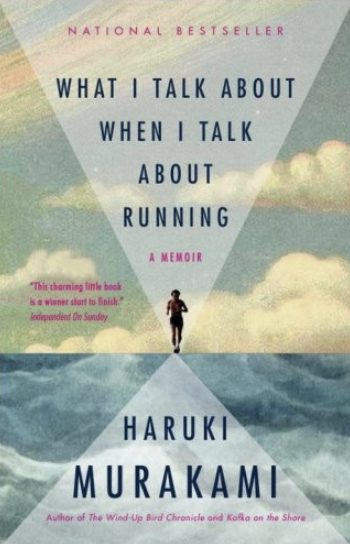 discontent. It also make me aware of how weak I am, how limited my abilities are…one of the results of running a little farther than usual is I become that much stronger…If I have a frustrating experience I use that to improve myself…I quietly absorb things I’m able to, releasing them later, and in as changed a form as possible, as part of the story line in a novel.”
I think for some creatives frustration (self-inflicted or otherwise) and criticism is naturally fuel. Some need an antagonist prompting you to work harder. For myself I have always found it flattening. The whole removing the wind from my sails, it makes it that much harder for me to move forward with a project. This paragraph has helped change my perspective a bit though. Using running as a medium to process that emotion, break it down into little pieces and then into fuel has been a big help. Something I liked about running in the past that Murakami also touches on is that it is inward competition. Distance runners are not always running to beat the runners next to them but to improve themselves. To shave off a second from their past best time and build towards their own goal. As Murakami puts it later in the book “…reaching the goal I set myself, under my own power.”
Around the 80-page mark Murakami makes what I think is one of the most important observations in this book. That creativity can be directly linked to physical and mental endurance.
“How much can I push myself? How much rest is appropriate — and how much is too much? How far can I take something and still keep it decent and consistent? When does it become narrow minded and inflexible? How much should I be aware of the world outside, and how much should I focus on my inner world? I know that if I hadn’t become a long-distance runner when I became a novelist, my work would be vastly different.”
All of these questions are equally applicable to running and to the creative process. My take-away from this is running teaches you boundaries. It also teaches how far those boundaries can be pushed in the appropriate amount of time without crashing and burning. It’s a balance between drive and ability and recognizing ability as a limit that can be expanded with practice.
So, I’ve been running. And it’s been helping. I don’t have any specific goal other than consistency. Consistent schedule, consistent pace, consistent mileage and consistent increase. I’m enjoying the ability to turn off when I run, to come back refreshed and accomplished and to find my limits expand a little more every time. My creative practices are starting to feel the benefit. Maybe it’s just endorphins from the exercise but larger hurdles, while still large, are a little less intimidating because I can jump higher than I could yesterday. So if you’re hurting for some inspiration, give this book (and running) a shot.
About the Author
Kyle Lopez
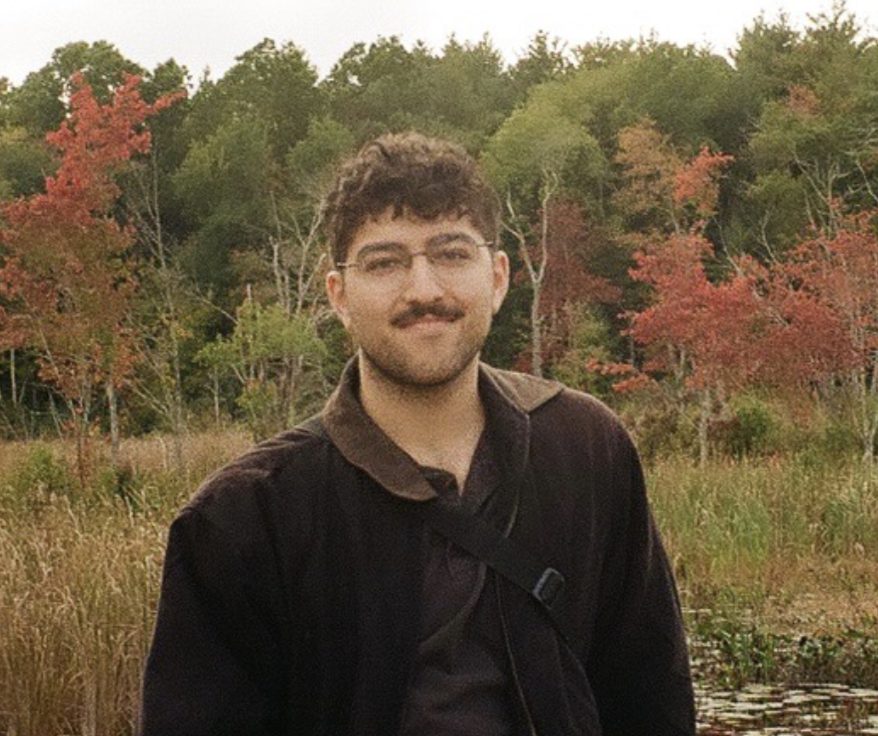
Kyle is a Visual/ Motion Designer at Williams and Helde. Previous to WH he spent multiple years in the specialty coffee industry as a barista, restaurant manager and coffee roaster. In his free time you’ll find him cooking, bike riding and taking photographs.